


The Purple Parade
What is The Purple Parade?
People with special needs are part of our community and should have equal access to opportunities and good quality of life.
The Purple Parade is a movement that supports the inclusion & celebrates the abilities of persons with special needs. We are making a movement towards a more inclusive society by opening our eyes to people with special needs in our community.
About our Purple Parade
 The Purple Parade brand is made up of a purple square and the brand name. Purple symbolises solidarity for people with special needs. Square symbolises equality (equal length on all sides), inclusiveness and strong building blocks.
Taken from: https://www.purpleparade.sg/
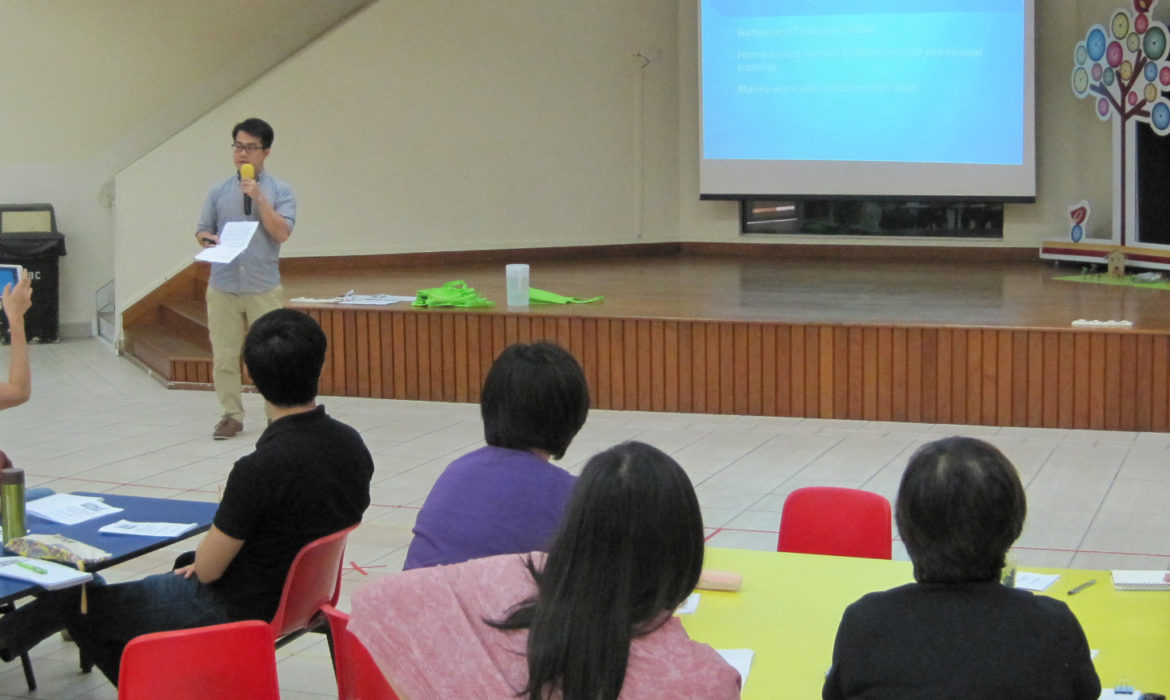
Teachers’ Training in Living Sanctuary Church Kindergarten
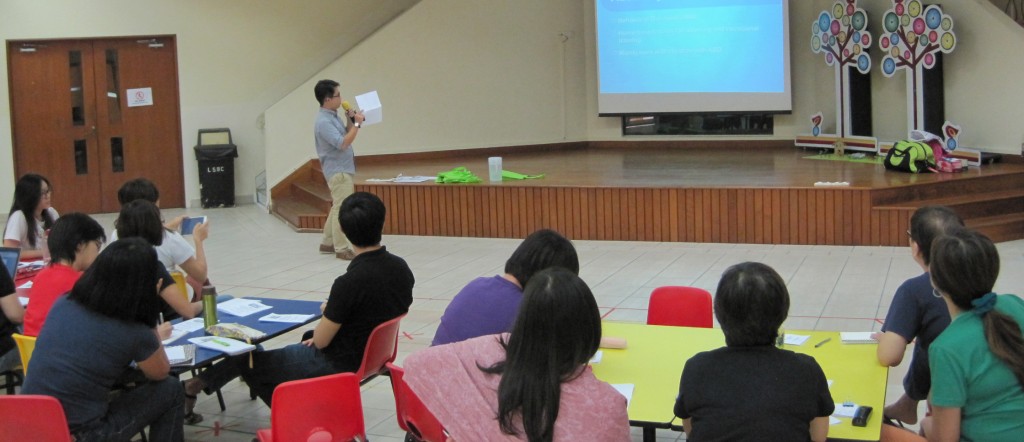 We will like to thank Living Sanctuary Church Kindergarten for inviting our Programme Manager, Mr Zhang Liyuan, for the sharing session.
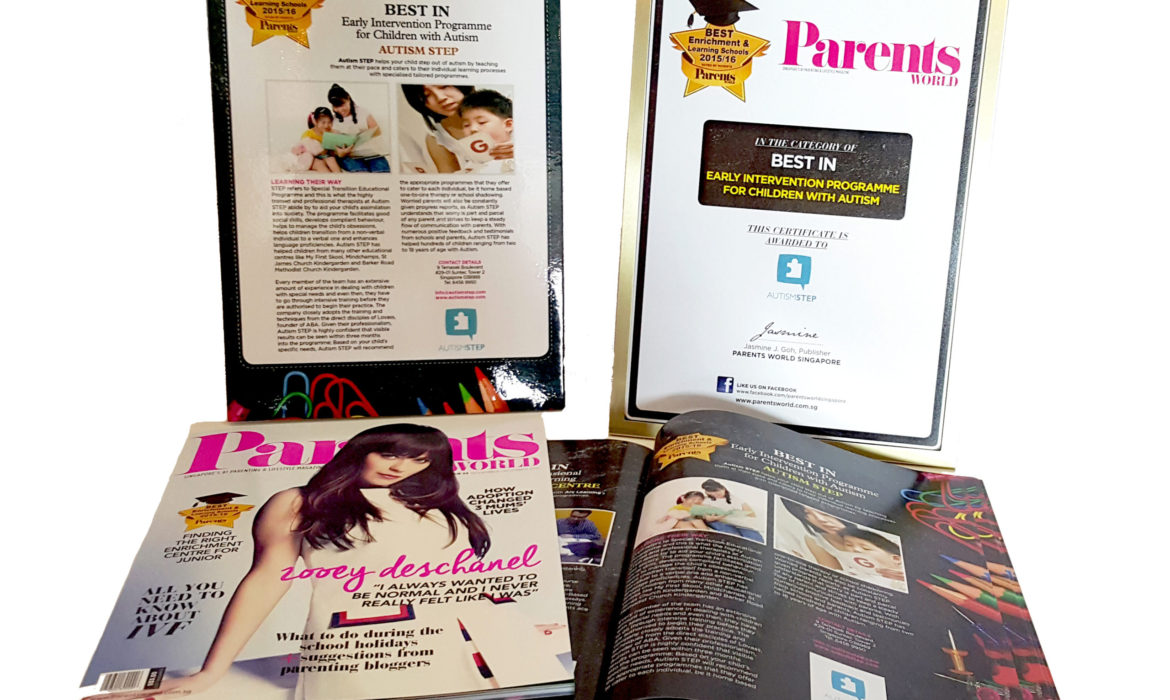
Autism STEP has been awarded! BEST IN EARLY INTERVENTION PROGRAMME FOR CHILDREN WITH AUTISM
Parent’s World, Singapore No.1 Parenting & Lifestyle magazine dedicated to inform and educate parents from all walks of life to better prepare the journey of parenting, has awarded Autism STEP for the Best Enrichment & Learning Schools 2015/2016 under the category of Best in Early Intervention Programme for Children with Autism. We are very honored and like to thank all those who have supported and believed in us to make this possible.


![20151112_134819[1]](https://www.autismstep.com//wp-content/uploads/2015/11/20151112_13481911-815x1024.jpg)

AMS-MOH Clinical Practice Guidelines
AMS-MOH Clinical Practice Guidelines is the first national guideline that incorporates the best available evidence from the scientific literature to assist all children with ASD and the healthcare professionals who work with them. Below is the extract of the Management:Intervention section with AutismSTEP adheres and strongly believes in.
Management: Intervention
- Every pre-school child diagnosed with ASD should have an individualised intervention plan that sets out the goals, type(s), frequency and intensity of intervention, in order to address particular developmental and educational needs.
- An individualised intervention plan should consist of a variety of quality programmes and activities. This includes attendance in comprehensive early intervention programmes, programmes targeting specific needs and also positive engagement with parents and/or caregivers.
- All pre-school children with ASD should undergo early intervention as soon as significant developmental need is recognized by a trained professional because outcomes improve with early intervention.
- The intensity of intervention should be continually monitored and varied according to the child’s changing need.
- Interventions for impaired communication should address the development of pivotal skills such as spontaneity, initiation, motivation and self-regulation.
- Interventions for impaired communication should aim to increase joint attention and symbolic play in order to improve expressive language development.
- There is no single language or communication intervention method that is appropriate for all children with ASD. The optimal communication intervention for an individual child with ASD depends on the needs of that particular child.
- Alternative-augmentative communication systems may be recommended for pre-school children with ASD because they expand (spoken or written) communication, may stimulate speech acquisition in non-verbal children and enhance expression in verbal children.
- Visual strategies are useful interventions for children with ASD because they offer visual support to communication, increase spontaneous imitation and socially communicative behaviour.
- Parent/caregivers should be educated that the use of alternative- augmentative communication systems or visual strategies neither inhibits speech nor replaces the development of expressive spoken language skills.
- Social skills are best taught explicitly through modeling and feedback.
- Social skills programmes depend on the functioning level of the preschool child with ASD and may include
– Assessment and teaching of social skills interaction in natural settings
– Provision of structure, visual cues and predictability
– Making abstract concepts more “concrete”.
– Activities that enable purposeful and appropriate interaction with typically developing peers.
– Goals focusing on fostering self-appreciation and self esteem. B Interventions for children with ASD with challenging behaviours based on functional behavioural assessment are recommended
- Children with ASD who present with perceptual distortions, fine and gross motor co-ordination difficulties, impaired play skills and impaired self-care and adaptability may benefit from consultation with appropriate specialists such as occupational therapists and/or physiotherapists.
- In the assessment and management of feeding difficulties in children with ASD, the healthcare professional needs to consider challenges in executive functioning, fears, sensory processing, social and language skills.
- Management of gastro-intestinal disorders and feeding difficulties in children with ASD may require collaboration between healthcare professionals such as primary care doctors, paediatricians, gastro- enterologists, dietitians and therapists.
- Environment, tasks and timing of activities of children with ASD should be adapted to minimize negative sensory reactions and meet their sensory needs.
- “Sensory integration” intervention is not recommended as standard therapy in management of children with ASD but may be considered where the child has sensory difficulties that affect daily functioning.
- Early Intensive Behavior Intervention (EIBI) can be recommended as an intervention option for children with ASD.
- Structured Teaching can be recommended as an intervention option for children with ASD.
- The Hanen “More Than Words®” programme may be considered as an intervention option for children with ASD.
- Developmental models such as Developmental, Individual-difference, Relationship-based (DIR)/Floortime and Relationship Development Intervention (RDI) models may be considered as intervention options for children with ASD.

Autism STEP is featured on TODAY Newspaper!
Autism STEP has been chosen to be featured on the Business section on 4th Feb 2016:
Better Ways To Cope With Your Child’s Autism.
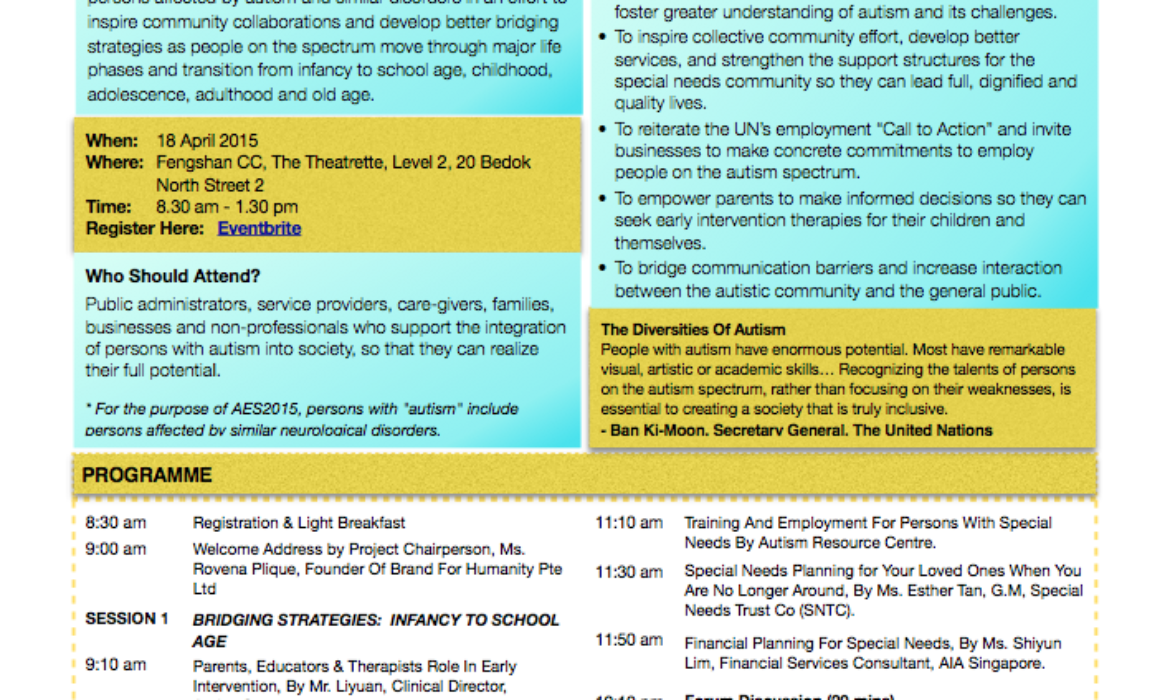
Autism Exposed Singapore
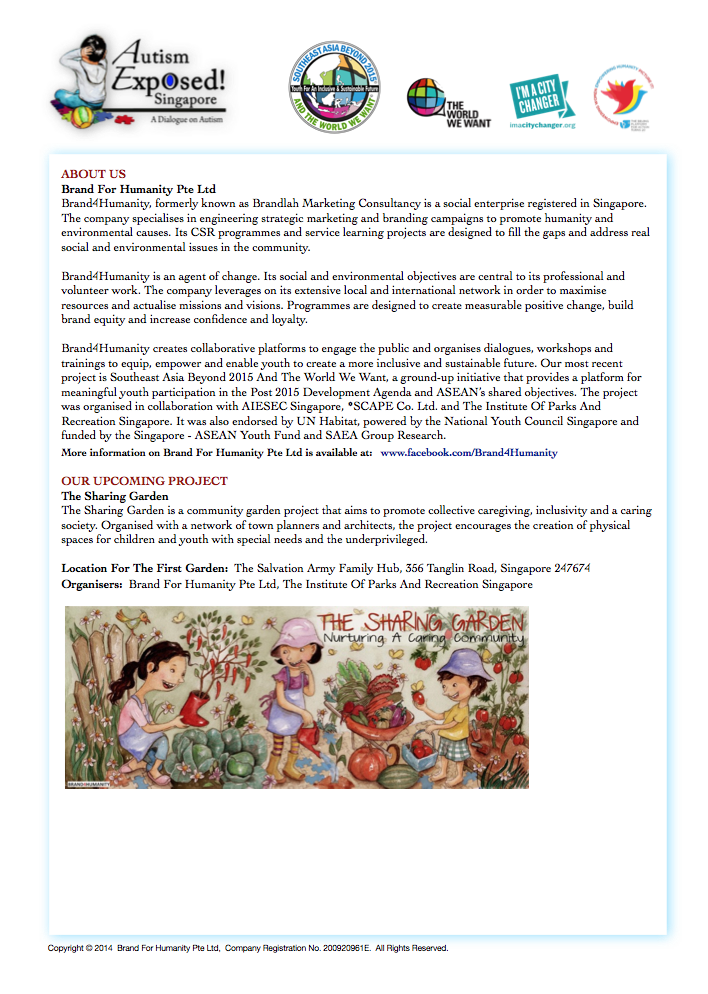
We like to thank Autism Exposed Singapore for inviting our Clinical Director, Mr Zhang Liyuan, to be one of the guest speakers.
The topic that he will be covering is the roles of parents, educators and therapists in early intervention for a child with Autism.
Interested party can register at http://www.eventbrite.sg/e/autism-exposed-singapore-2015-a-community-dialogue-on-autism-tickets-16494975917

Autism STEP is now a Baby Bonus Approved Institution!
We are now a Baby Bonus Approved Institution! Below is the scheme that our organisation is approved for.
Child Development Account (CDA) for children eligible for Baby Bonus
The CDA is a special savings account that you open at any OCBC Bank or Standard Chartered Bank (Singapore) Limited branch for your child who is eligible for CDA. You can save in the CDA any time until 31 December in the year your child turns 12 years of age. The savings will be matched dollar-for-dollar up to the cap of $6,000 each for the first and second child, $12,000 each for the third and fourth child and $18,000 each for the fifth and subsequent child. The Government will match your savings in the following month.
We thank you for participating in the Child Development Co-savings Scheme, and hope you have found it useful. As part of the Government’s efforts to save the environment, we will stop sending hardcopy updates on Government’s matching contribution to your child’s CDA and the remaining cap, from 1 June 2014. Should you wish to check on the status of your CDA remaining cap, you may login to do so. You would also be able to monitor your CDA deposits and the matching contribution by Government, through your bank statements.
The savings in the CDA may be used to pay approved expenses for all your children approved institution registered with the Ministry of Social and Family Development (MSF) under the Baby Bonus Scheme. These include child care centres licensed by MSF, kindergartens and special education schools registered with the Ministry of Education (MOE) or the Council for Private Education (CPE), early intervention programmes registered with the National Council of Social Service (NCSS) or SG Enable, healthcare institutions licensed under the Private Hospitals and Medical Clinics (PHMC) Act, pharmacies registered with the Health Sciences Authority (HSA), optical shops registered with the Accounting and Corporate Regulatory Authority (ACRA) and assistive technology devices providers registered with ACRA or known to either the Ministry of Health (MOH) or SG Enable. The CDA savings can also be used to purchase MediShield or Medisave-approved private integrated plans for all your children. To know if you are eligible for baby bonus, please visit www.babybonus.gov.sg for more information.

A Mindmap of behaviors management
We always try to find out what is the antecedent or cause of a behavior. There are 4 main categories what triggers the behaviors of people with autism. The 4 main categories are as follow:
- Attention – They want your attention
- Escape – It is their way to try to get away from a situation
- Tangibles – There may be a certain tangible (eg. toy, sweet, etc) that they want
- Sensory – They need a sensory input
The picture is a Mind Map of the different reason why a child with autism may exhibit difficult behaviors and how do we deal with them.
 AutismSTEP