

Introduction
Parents often begin asking whether autistic people know they are autistic when they observe their child facing challenges that seem difficult to explain. These challenges may involve social interactions, sensory sensitivities, emotional regulation, or processing instructions in busy classroom environments. The child may not yet have the language to describe these experiences, but parents notice patterns that suggest the child feels different from their peers.
In many cases, the question if autistic people know they are autistic emerges when parents see signs that their child is aware of their own differences, even if they cannot explain why. A child may react strongly to loud environments, feel overwhelmed in group settings, or struggle to interpret social rules that other children appear to grasp easily.
For many children, the earliest form of awareness begins with noticing differences in how they experience everyday situations. Long before they understand diagnostic labels, they may recognise that certain environments feel overwhelming, that they need more time to process instructions, or that social expectations feel confusing.
This emerging awareness is often described as autism self-awareness. It refers to how a child gradually begins to understand their own experiences, reactions, and needs. It does not require knowledge of clinical terms or diagnostic categories. Instead, it involves recognising personal patterns in emotions, sensory responses, and communication styles.
When parents ask do autistic people know they are autistic, they are often trying to understand how much their child already perceives about themselves. In reality, many children recognise differences in their experiences long before they learn the word autism.
Developing awareness helps children make sense of their experiences. When a child understands that their reactions have a neurological basis rather than being personal failures, it can reduce confusion and emotional distress.
In Singapore, awareness of developmental conditions has grown through national initiatives and education campaigns. Organisations such as SG Enable and the Autism Resource Centre have contributed to broader public understanding, while schools increasingly recognise the importance of inclusive learning environments. Even so, families still navigate complex questions about how and when to discuss autism with their child.
The question do autistic people know they are autistic therefore becomes less about a single moment of realisation and more about how understanding develops over time. How adults respond to a child’s questions, experiences, and challenges can significantly shape how they interpret their differences.
This article explores how awareness develops in childhood, the challenges parents face when discussing autism, and how supportive conversations can help children build a healthy sense of identity and confidence.
Key Takeaways
- Many parents wonder if autistic people know they are autistic during childhood, especially when a child senses differences before receiving a formal explanation.
- Children often recognise that their experiences differ from those of their peers before they understand autism as a concept.
- Explaining differences in supportive language can reduce confusion, self-blame, and emotional distress.
- A child’s awareness develops gradually through age, communication ability, and the way adults discuss differences.
- Families in Singapore can benefit from professional guidance, early intervention resources, and community support when navigating conversations about autism.
How Awareness Develops in Children
Do Autistic Children Know They Are Different Before They Know They Are Autistic?
One of the most important insights when exploring whether autistic people know they are autistic is that awareness often begins long before diagnosis.
Many children recognise that certain experiences feel different for them. They may struggle with sensory overload, find group conversations confusing, or feel anxious when routines change unexpectedly. These experiences often create a sense that something about their daily life feels harder than it appears for others.
Children who notice these differences may ask questions such as:
- Why do loud noises bother me so much?
- Why does everyone else understand the rules of the game?
- Why do I need more time to finish tasks?
In these moments, children are already reflecting on their experiences, even if they do not know the explanation.
When parents ask do autistic people know they are autistic, the more accurate perspective is that children often know they are different before they understand the reason.
This awareness can appear in various ways. Some children may express frustration when they cannot keep up with classroom expectations. Others may withdraw from social situations or become anxious before school.
Children may also attempt to imitate their peers in order to fit in. This effort to copy behaviour, often described as masking, can occur when children sense that their natural responses stand out.
These behaviours often indicate insight rather than a lack of awareness. The child recognises a mismatch between their internal experience and external expectations.
When differences remain unexplained, children may internalise them negatively. They may assume that they are failing or that something is wrong with them.
This is one reason parents frequently ask do autistic people know they are autistic, hoping to understand how much their child already perceives about themselves.
Recognising these early signals allows adults to respond with empathy and clarity rather than leaving the child to interpret their experiences alone.
In some cases, communication challenges may make it harder for children to express their feelings about these differences. Support, such as children’s speech therapy, can help children articulate emotions, ask questions, and participate more comfortably in social environments.
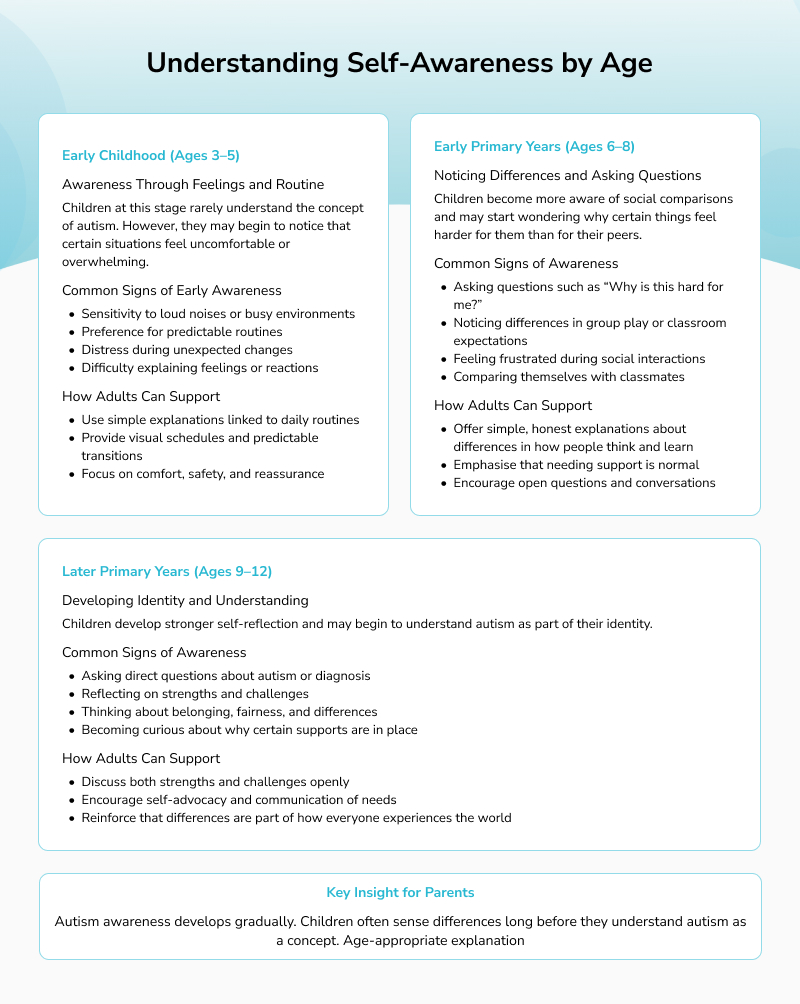
Autism Awareness in Children at Different Ages
When considering whether autistic people know they are autistic, it is helpful to understand how awareness evolves across developmental stages.
Early Childhood (Ages 3–5)
Young children may recognise sensory discomfort or difficulty with transitions, but they are unlikely to understand diagnostic concepts.
Parents may notice that a child prefers predictable routines or becomes distressed in noisy environments. Rather than discussing autism directly, explanations at this stage often focus on comfort and support.
Children may learn simple ideas such as:
- Some places feel too loud for your ears.
- Breaks help your body calm down.
- Visual schedules help you know what comes next.
These explanations allow children to understand their needs without overwhelming them with complex information.
Early Primary Years (Ages 6–8)
As children enter primary school, they become more aware of social comparisons.
They begin noticing differences in how classmates communicate, participate in group activities, or respond to instructions. During this stage, parents often revisit the question do autistic people know they are autistic, especially when children begin asking more direct questions.
Children might ask why they need extra support in class or why certain activities feel more difficult.
At this point, simple and honest explanations can help reduce confusion. Understanding differences in how the brain processes information can reassure children that needing support does not mean they are failing.
Later Primary Years (Ages 9–12)
Older children develop stronger reflective abilities. They start thinking more deeply about identity, fairness, and belonging.
When parents ask do autistic people know they are autistic, this age group often demonstrates a growing capacity to understand broader explanations.
Children may ask more detailed questions about why they attend therapy sessions or receive specific accommodations in school.
At this stage, conversations can expand to include both challenges and strengths. Discussions about how different people process information differently can help children build a balanced perspective of themselves.
These conversations support the development of autism awareness in children, helping them integrate their experiences into a clearer understanding of who they are.
Should Autism Be Explained to Children?
Parents often hesitate to discuss autism directly. They worry that labels may limit their child or affect their self-esteem.
However, research and lived experiences from autistic adults suggest that explanation is often less harmful than silence.
Children who notice differences but receive no explanation may create their own interpretations. Without context, they may assume that struggles are personal failures.
This is why the question “do autistic people know they are autistic” cannot be separated from the environment around them.
When explanations are supportive and respectful, children often experience relief rather than distress.
Discussing autism does not mean defining a child solely by diagnosis. Instead, it helps with understanding autism diagnosis as one piece of information that explains certain experiences.
For some families, guidance from an autism therapist in Singapore can help structure these conversations in ways that feel developmentally appropriate.
Parental Challenges and Approaches
Fear of Labels and Stigma
Parents frequently worry about how the autism label might affect their child.
In Singapore, social awareness of autism has improved in recent years. Initiatives such as the Enabling Masterplan and community programmes supported by SG Enable have encouraged inclusion and support.
Despite this progress, families may still worry about stigma in schools or social environments.
These concerns often surface when parents ask do autistic people know they are autistic, hoping to delay difficult conversations.
However, avoiding the topic does not eliminate awareness of differences. Children may still recognise that they experience the world differently, but without an explanation.
Addressing autism in a calm and supportive way can help reduce shame rather than create it.
Finding the Right Language and Timing
Many parents search for the perfect moment to explain autism.
In reality, conversations usually unfold gradually. Children ask questions at different stages, and parents respond with explanations that evolve over time.
When families ask do autistic people know they are autistic, the focus should shift from timing to tone.
Language that emphasises differences in how the brain processes information can help children understand their experiences without feeling judged.
Professional support, such as speech therapy, can also help children develop communication skills that allow them to express questions and emotions more clearly.
Supporting Healthy Identity Development
Identity development is shaped by how children interpret their experiences.
When children receive explanations that acknowledge both strengths and challenges, they are more likely to develop a balanced view of themselves.
This process contributes to the formation of autistic self-identity, which involves understanding autism as one part of a broader sense of self.
Parents play a key role in shaping this perspective. Conversations that emphasise strengths, creativity, and resilience can help children feel valued.
Families sometimes revisit the question do autistic people know they are autistic during adolescence, when identity questions become more prominent.
Positive representation and supportive communities can help children see that neurological differences are part of human diversity rather than a flaw.
Professional Support for Children and Families
Some families find it challenging to navigate these conversations alone.
Professional guidance can help bridge the gap between observation and understanding. Specialists can support both children and parents in making sense of experiences in ways that feel safe and constructive.
For children, therapeutic support can focus on communication, emotional regulation, and social understanding.
Options may include home-based speech therapy in Singapore, which allows children to practise communication skills within familiar environments.
Support systems in Singapore also include early intervention programmes and community initiatives that help families access resources.
When parents ask do autistic people know they are autistic, professionals can help assess how much the child already understands and how best to approach conversations.
Guided discussions often help children connect their experiences with explanations that feel reassuring rather than confusing.
Frequently Asked Questions
Do autistic people know they are autistic if no one tells them?
Many children sense that they experience the world differently even if no one explains autism directly. Without context, they may interpret these differences negatively. This is why parents often ask do autistic people know they are autistic, hoping to understand what their child already perceives.
Is it harmful to tell a child they are autistic?
When explanations are age-appropriate and supportive, learning about autism can reduce confusion. Understanding differences often helps children feel reassured rather than labelled.
What if my child reacts negatively to learning about autism?
Children may experience mixed emotions initially. With supportive conversations and time, many children begin to integrate the information into a clearer understanding of themselves.
Should autism be explained before or after diagnosis?
Some families start discussing differences before a formal assessment. Others wait until after receiving professional confirmation. The most important factor is responding honestly to a child’s experiences.
Conclusion
The question do autistic people know they are autistic does not have a single answer. Awareness develops gradually through everyday experiences, interactions with others, and the explanations children receive from the adults around them.
Children often sense differences long before they understand autism as a concept. When those experiences are explained with empathy and clarity, children can interpret their differences as part of how their brain works rather than as personal shortcomings.
Families in Singapore increasingly have access to supportive resources, community programmes, and professional services that help children build understanding and confidence.
At AutismSTEP, we support families navigating these conversations by helping children develop self-understanding in ways that are respectful, age-appropriate, and grounded in real experiences.
Our team works closely with parents to guide children through this process with clarity and care. If you are navigating questions about your child’s experiences and wondering whether autistic people know they are autistic, our specialists can provide practical guidance tailored to your family’s needs.
Contact us to explore how personalised support can help your child develop confidence, understanding, and a stronger sense of self as they grow.
 AutismSTEP