

Excelling with
ABA-VB Therapy
With licensed therapists and a fully personalised programme, our ABA-VB (Applied Behavioural Analysis
– Verbal Behaviour) Therapy helps your child unlock their behavioural and verbal potential.

GETTING TO KNOW
Applied Behavioural Analysis – Verbal Behaviour
ABA-VB Therapy reaps the benefits of positive reinforcement for meaningful improvement of multiple aspects of your child’s verbal and behavioural development. Every single one of AutismSTEP’s therapists are Registered Behavioral Technicians (RBTs) licensed or undergoing licensing by registered Board Certified Behavior Analysts (BCBAs).
For families who prefer intervention within a familiar environment, Home-Based ABA Therapy Sessions provide an option for consistent skill-building at home, allowing strategies to be reinforced in everyday routines while maintaining professional supervision.
Every single one of AutismSTEP’s applied behaviour analysis therapist are Registered Behavioural Technician (RBTs) licensed or undergoing licensing by registered Board Certified Behavior Analysts (BCBAs). This professional structure aligns with principles highlighted in NCBI Applied Behaviour Analysis, which emphasise the importance of therapist training, supervision, and treatment fidelity in delivering structured and evidence-informed behavioural intervention.

Understanding Different Types of ABA Treatments
ABA therapy can be adapted in different ways depending on a child’s developmental profile, learning style, communication abilities, and daily needs. These ABA treatments may take place in structured settings, natural environments, or a combination of both to support skill development more effectively.
Discrete Trial Training (DTT)
Discrete Trial Training is a structured teaching method that breaks skills into smaller, manageable steps. Each skill is taught through repetition, guided prompts, and reinforcement to help children build understanding progressively.
This approach is often used for foundational learning areas such as communication, following instructions, matching, imitation, and early academic concepts.
Natural Environment Teaching (NET)
Natural Environment Teaching focuses on learning within everyday situations and activities. Skills are taught through play, routines, and naturally occurring interactions to encourage more spontaneous communication and engagement.
This approach helps children apply learned skills more naturally across home, school, and community settings.
Verbal Behaviour (VB) Therapy
Verbal Behaviour therapy places greater emphasis on communication and language development. Children are guided to understand the purpose behind words and communication, rather than memorising responses alone.
Sessions may focus on requesting, labelling, answering questions, and improving conversational interaction in functional ways.
Social Skills Training
Social skills sessions help children develop interaction skills that support everyday communication and relationships. Areas of focus may include turn-taking, joint attention, emotional understanding, and responding to social cues.
These sessions can take place individually or in small-group settings, depending on the child’s needs and readiness.
Parent and Caregiver Training
Parent involvement plays an important role in supporting consistency outside therapy sessions. Caregiver training helps families understand behavioural strategies, communication techniques, and ways to reinforce learning during daily routines.
This collaborative approach allows therapy goals to extend more naturally into the child’s home environment.
How ABA Treatments Support Children Over Time
Different ABA treatments are designed to support a child’s development across communication, behaviour, learning, and everyday functioning. Support is typically personalised based on the child’s strengths, challenges, and developmental goals.

Builds Foundational Communication Skills
Many children experience challenges with expressing needs, understanding language, or engaging in conversation. ABA therapy helps break communication into smaller, teachable steps that can be reinforced consistently over time.
Sessions may focus on requesting, following instructions, responding to questions, and improving expressive language in daily situations.

Strengthens Social Interaction and Play
Social interaction can be difficult for some children, particularly in group settings or unfamiliar environments. Therapy sessions help children practise turn-taking, shared attention, emotional recognition, and interactive play in structured yet supportive ways.
These experiences help children become more comfortable engaging with peers, caregivers, and educators.

Encourages Independence in Daily Routines
Daily living skills are often an important focus within ABA therapy. Children may be guided through routines such as dressing, eating, toileting, transitioning between activities, or following simple instructions independently.
An applied behaviour analysis therapist uses structured reinforcement and repetition to help children build confidence in these everyday tasks progressively.

Reduces Challenging Behaviours Thoughtfully
Some behaviours may develop because a child struggles to communicate needs, cope with sensory input, or manage frustration. ABA approaches aim to understand the reasons behind behaviours rather than simply stopping them.
Strategies are then introduced to encourage safer, more functional ways of communicating and responding.

Creates Personalised Learning Plans
No two children learn in exactly the same way. Therapy plans are usually adapted according to developmental level, learning pace, communication style, and behavioural needs.
This flexibility allows different ABA treatments to be adjusted as the child progresses over time.

Empowers Parents and Caregivers
Caregiver involvement remains an important part of long-term developmental support. Parents are often guided on how to reinforce learning, support routines, and apply strategies more consistently at home.
This collaborative approach helps create greater continuity between therapy sessions and daily life experiences.
How Our ABA Treatment Process Supports Your Child
Every child develops differently, which is why our approach to ABA treatments begins with understanding each child’s unique strengths, challenges, and learning needs. From the first consultation to ongoing therapy support, each step is guided through structured planning and continuous review.
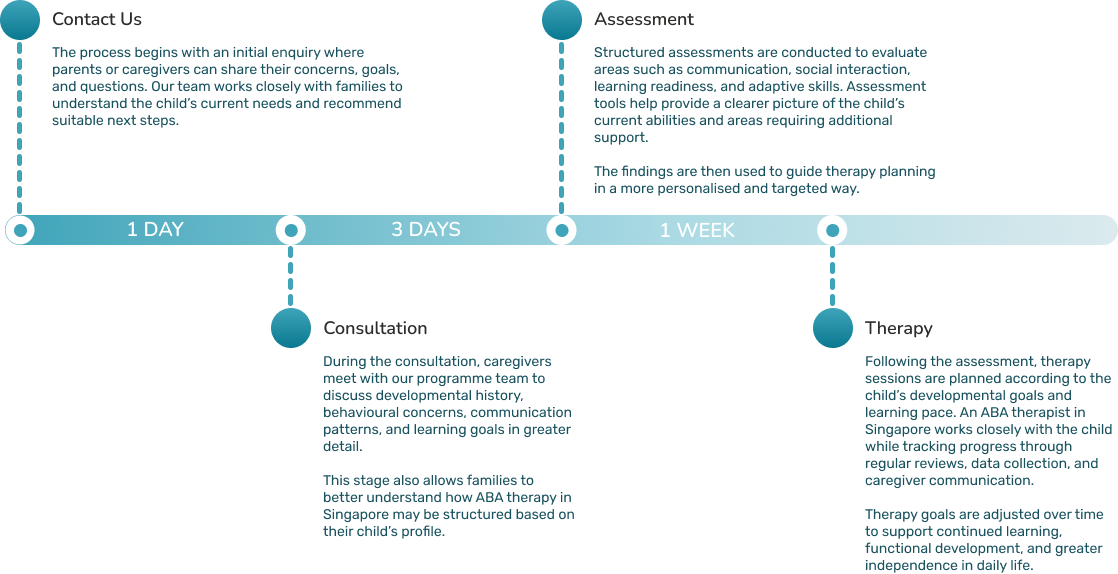
Contact Us
The process begins with an initial enquiry where parents or caregivers can share their concerns, goals, and questions. Our team works closely with families to understand the child’s current needs and recommend suitable next steps.
Consultation
During the consultation, caregivers meet with our programme team to discuss developmental history, behavioural concerns, communication patterns, and learning goals in greater detail.
This stage also allows families to better understand how ABA therapy in Singapore may be structured based on their child’s profile.
Assessment
Structured assessments are conducted to evaluate areas such as communication, social interaction, learning readiness, and adaptive skills. Assessment tools help provide a clearer picture of the child’s current abilities and areas requiring additional support.
The findings are then used to guide therapy planning in a more personalised and targeted way.
Therapy
Following the assessment, therapy sessions are planned according to the child’s developmental goals and learning pace. An ABA therapist in Singapore works closely with the child while tracking progress through regular reviews, data collection, and caregiver communication.
Therapy goals are adjusted over time to support continued learning, functional development, and greater independence in daily life.
Frequently Asked Questions About ABA Therapy in Singapore
How much does ABA therapy cost in Singapore?
ABA therapy costs in Singapore depend on the provider, duration, and added services. For accurate costs, contact specific providers. This therapy requires trained professionals and personalised plans, costing thousands of dollars monthly. You can find financial aid through the government, insurance, or autism support groups. Check with local providers for current cost information.
What is ABA in Singapore?
Applied Behavior Analysis (ABA) is a behavioural therapy used in Singapore for those with autism and developmental disabilities by using systematic observation to change behaviour. Singapore’s ABA programs are tailored and intensive, improving social skills, communication, academics, and independence. For detailed information on local ABA services, reach out to local providers and professionals.
What is the success rate of ABA therapy?
The success rate of Applied Behavior Analysis (ABA) therapy varies depending on the individual, targeted goals, and intervention intensity. Early and intensive ABA therapy can lead to significant improvements in communication, social skills, adaptive behaviours, and academics. However, outcomes may differ based on individual circumstances, and success is not universally guaranteed.
Does ABA help with behaviour problems?
ABA therapy is recognised in the medical sector for effectively addressing behavioural challenges in individuals with autism spectrum disorder (ASD) and developmental disabilities through systematic observation and reinforcement techniques. It teaches adaptive behaviours, communication skills, and social interactions while reducing challenging behaviours. While outcomes may vary, evidence-based strategies and personalised treatment plans contribute to positive results and an enhanced quality of life.
What is the age limit for ABA therapy?
ABA therapy is beneficial for individuals of various ages, with early intervention typically initiated during early childhood (around ages two to five). However, ABA can also be effective for older children, teenagers, and adults, as the principles of behaviour analysis can address behavioural challenges across the lifespan. Consultation with ABA professionals helps determine the most suitable and effective approach for individuals of different ages and developmental stages.
MEET OUR FAMILIES
Read their success stories


 AutismSTEP