
Introduction
When a child struggles to pronounce certain sounds clearly, parents are often told that the issue relates to “speech sound errors.” This term can feel broad and confusing, especially when different therapy approaches are mentioned early on. Articulation therapy is one option that is frequently recommended, but it does not apply to every type of speech sound difficulty.
In Singapore, concerns about pronunciation often become noticeable when children enter preschool or kindergarten. Teachers may observe that classmates struggle to understand a child during show-and-tell sessions, reading activities, or group discussions. These observations sometimes lead parents to explore speech therapy support to better understand the child’s speech development.
The transition into formal schooling can also bring additional communication demands. Under Singapore’s education system, the Ministry of Education (MOE) emphasises classroom participation, oral communication, and collaborative learning from the early years. When speech sound errors reduce clarity, children may experience difficulty contributing confidently in these situations.
At home, parents may notice similar patterns during conversations with relatives or in social environments such as childcare centres and playgrounds. While some speech errors are part of normal development, others persist longer and begin to affect daily communication.
Understanding where articulation therapy fits within speech development allows families to make informed decisions about whether support is necessary and what type of intervention may be appropriate.
Key Takeaways
- Articulation therapy supports children who struggle with producing specific speech sounds accurately.
- Speech sound errors can arise from different causes, including articulation difficulties or sound pattern differences.
- When speech clarity in children is affected, communication, classroom participation, and social interaction may become more challenging.
- Understanding the purpose of articulation therapy helps parents recognise when this approach is appropriate and when other forms of support may be needed.
- In Singapore, early guidance from professionals can help families decide whether structured speech support is necessary.
Understanding Speech Sound Errors
What Speech Sound Errors Refer To
Speech sound errors describe difficulties with producing speech sounds clearly and consistently enough to be understood. These errors may involve substituting sounds, omitting sounds, distorting sounds, or producing them inaccurately.
Examples include:
- Saying “wabbit” instead of “rabbit”
- Saying “poon” instead of “spoon”
- Dropping final sounds such as “ca” instead of “cat”
Some speech errors are typical during early development. Young children are still learning how to coordinate tongue movement, airflow, and sound placement. Certain sounds appear later as motor control improves.
However, when these patterns persist beyond expected developmental stages, they may begin to affect communication.
In Singapore, speech development is often monitored informally by preschool educators and childcare professionals. When persistent sound errors are observed, families may explore children’s speech therapy services to better understand the child’s communication profile.
Local healthcare providers and early childhood professionals typically encourage observation over time rather than immediate intervention unless speech clarity significantly affects understanding.
When a child is consistently difficult to understand, however, structured approaches such as speech articulation training may be considered following assessment.
Is There Something Wrong With My Child?
Many parents worry that persistent speech sound errors mean something is seriously wrong with their child. In most cases, this is not so. Speech development varies widely among children, and some sounds naturally take longer to master than others. Temporary pronunciation errors can be part of normal learning as children develop coordination of the tongue, lips, and airflow.
It is also common for children to show uneven progress. A child may pronounce certain sounds correctly in familiar words but struggle with them in new or longer words. This does not necessarily indicate a long-term speech difficulty.
In Singapore, preschool teachers and early childhood educators often monitor speech development informally during daily classroom activities. When concerns arise, they may suggest observation over time or recommend seeking professional guidance. The goal is not to label a child, but to better understand how speech development is progressing.
If sound errors persist or begin to affect everyday communication, a professional assessment can provide clarity. Early guidance helps determine whether the patterns reflect typical development or whether targeted support may help the child produce speech sounds more clearly.
Why Not All Speech Sound Errors Are the Same
Although speech sound errors may appear similar, they can arise from different underlying causes.
Some children struggle with articulation difficulties, which relate to the physical production of sounds. Others show challenges with how sounds are organised across words.
Understanding this distinction is important because the therapy approach must match the underlying difficulty.
For example:
| Speech Challenge | Description | Example |
| Sound production issue | Difficulty forming a specific sound physically | “wabbit” instead of “rabbit” |
| Sound pattern difference | A consistent rule applied across many words | “tar” instead of “car” |
Without understanding the root cause, it can be difficult to determine whether therapy is appropriate.
Speech therapists typically examine how sounds are produced across different contexts before recommending intervention. This assessment helps determine whether therapy should be introduced or whether another speech sound approach would be more suitable.
In Singapore’s multilingual environment, children may also navigate multiple languages at home and school. Speech patterns may vary between languages, which means professionals often consider linguistic exposure before recommending therapy for speech sound production.
When Speech Sound Errors Begin to Affect Communication
Speech sound errors become more concerning when they interfere with everyday communication.
Children may begin to experience:
- Difficulty being understood by unfamiliar listeners
- Frustration when repeating themselves
- Reduced participation in conversations
- Hesitation when speaking in groups
In Singapore classrooms, where oral interaction forms part of everyday learning, these challenges may become more visible. Students frequently engage in activities such as reading aloud, answering questions, or participating in group discussions.
When speech clarity is reduced, children may avoid speaking or rely more heavily on gestures.
Over time, communication difficulties may influence confidence in social and academic environments.
Communication differences in autistic children
Speech sound errors may also appear alongside broader communication differences in autistic children.
In these situations, unclear speech may not be the only factor affecting interaction. Some children may understand language well but struggle to express ideas clearly enough for others to follow.
Families who already work with an autism therapist in Singapore may notice that speech clarity interacts with other aspects of communication, including sensory regulation, processing speed, or social interaction.
For these children, the presence of speech sound errors may add a layer of communication complexity.
Understanding the child’s full communication profile helps determine whether articulation therapy should be part of the support plan.
Articulation Errors vs Phonological Errors
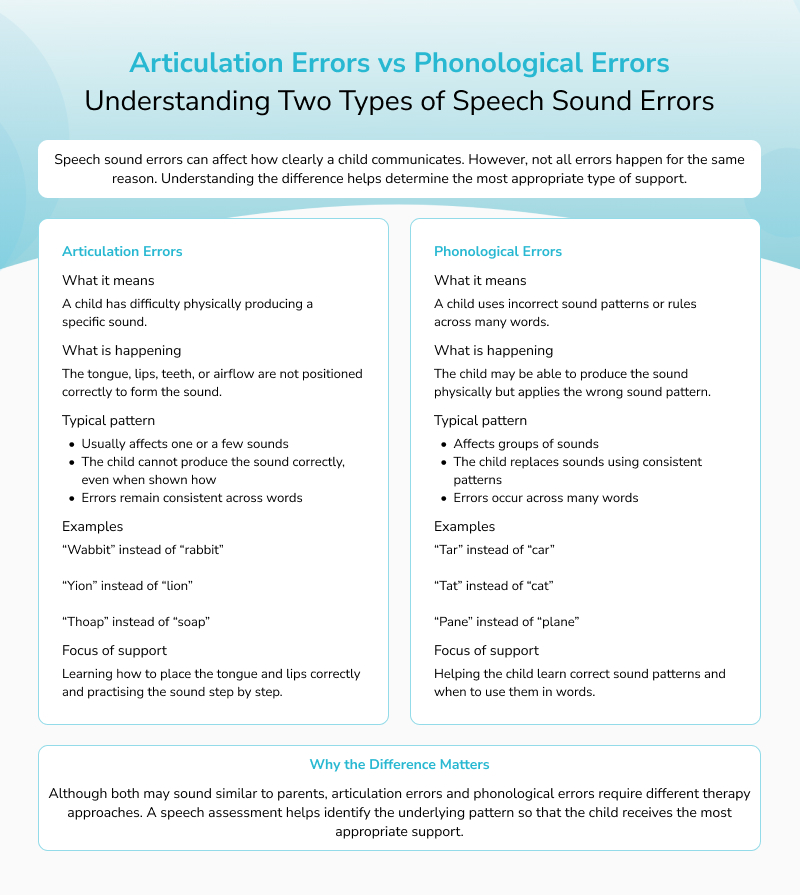
Speech sound errors generally fall into two broad categories: articulation errors and phonological errors.
Articulation errors
Articulation errors occur when a child cannot physically produce a specific sound.
For example:
- “wabbit” instead of “rabbit”
- “yion” instead of “lion”
These errors usually affect one or a small number of sounds.
In such cases, vocal therapy may help the child learn how to position the tongue, lips, and airflow correctly to produce the sound.
Phonological errors
Phonological errors involve sound patterns affecting groups of words.
Examples include:
- “tar” instead of “car”
- “tat” instead of “cat”
In these cases, the child may physically be able to produce the sound but use incorrect sound rules.
Because the underlying difficulty differs, therapy approaches may vary. While pronunciation-focused speech therapy focuses on sound production, other methods target sound pattern organisation.
A comprehensive speech assessment helps determine whether articulation intervention is appropriate.
Where Articulation Therapy Fits In
What Articulation Therapy Is Designed to Address
Articulation therapy focuses on helping a child learn how to produce specific speech sounds accurately.
The goal is to guide the child through structured practice that builds motor control and awareness of sound placement.
During therapy, children learn:
- where sounds are formed in the mouth
- how airflow contributes to sound production
- how to coordinate tongue and lip movement
The process often follows a step-by-step progression.
Typical stages include:
- Producing the sound in isolation
- Producing the sound in syllables
- Producing the sound in words
- Using the sound in phrases
- Using the sound in everyday conversation
This progression allows the child to build motor accuracy gradually.
In Singapore, therapy sessions often incorporate visual cues, modelling, and interactive exercises to make learning accessible for young children.
When Articulation Therapy May Be Appropriate
Articulation therapy may be appropriate when a child consistently mispronounces specific sounds and struggles to produce them correctly, even after hearing accurate models.
In these situations, the child is guided to understand how the sound should be produced and provides opportunities to practise it repeatedly.
The structure usually begins with sound awareness. Children learn to recognise the difference between correct and incorrect production.
As the child gains confidence, vocal support progresses through increasingly complex levels of speech.
Eventually, speech clarity training focuses on helping the child use the sound consistently in everyday communication.
Some families choose home-based speech therapy in Singapore, where therapists guide practice within familiar routines. Practising speech sounds in daily interactions may help children apply what they learn during structured sessions.
What Articulation Therapy Does Not Address
Although articulation therapy can support sound production, it does not address all communication challenges.
Several misconceptions are common.
First, they do not target broader sound pattern systems. When a child’s speech errors involve consistent phonological patterns, another therapy approach may be required.
Second, they do not address language development areas such as vocabulary, sentence structure, or comprehension.
Third, the articulation intervention programme is not used as a diagnostic tool. Decisions about intervention should always follow a comprehensive speech and language assessment.
The effectiveness of the intervention also depends on several factors, including:
- number of sounds involved
- consistency of errors
- attention to speech models
- opportunities for practice
Understanding these factors helps families develop realistic expectations about progress during therapy.
When to Seek an Assessment
Parents often wonder when speech sound errors move beyond typical development.
Some signs that further evaluation may be helpful include:
- frequent difficulty being understood by unfamiliar listeners
- persistent sound errors beyond expected ages
- frustration during communication
- limited improvement in speech clarity over time
In Singapore, teachers may raise speech concerns during preschool or early primary school years. The MOE learning environment encourages oral communication and collaborative learning, which may highlight speech clarity challenges.
A speech assessment typically examines:
- how the child produces sounds across words
- patterns of sound errors
- speech consistency across contexts
- communication style and developmental history
Assessment helps determine whether support for clearer speech sounds would be beneficial or whether another type of intervention would better support the child’s speech development.
Frequently Asked Questions
How is articulation therapy different from other speech sound approaches?
Articulation therapy focuses on improving the production of specific speech sounds, while other approaches target sound patterns affecting groups of words.
Does every child with unclear speech need articulation therapy?
No. Some speech sound errors resolve naturally during development. Articulation therapy is recommended only when sound production difficulties persist.
Can articulation therapy help if a child can say the sound sometimes but not consistently?
Yes. In some cases, therapy for clearer pronunciation can help improve consistency by strengthening sound placement and motor coordination.
How long does articulation therapy usually take?
The duration varies depending on the number of sounds involved, consistency of errors, and practice opportunities.
What role do parents play during articulation therapy?
Parents often help reinforce skills learned during articulation therapy by encouraging natural speech practice during everyday interactions.
Conclusion
Speech sound errors can appear similar on the surface but often reflect different underlying challenges. Understanding these differences helps families avoid assuming that a single therapy approach will suit every child. Careful assessment ensures that support focuses on the root cause of unclear speech rather than only the symptoms.
When sound production is the primary difficulty, early pronunciation support can help children develop clearer pronunciation through structured practice and gradual skill building. However, therapy decisions should always be guided by a comprehensive understanding of the child’s communication profile, developmental stage, and learning environment.
How Autism STEP Supports Children With Speech Sound Development
At AutismSTEP, families are supported through a structured and individualised process that focuses on practical outcomes for children. The team conducts careful communication assessments before recommending any intervention, ensuring that any therapy is introduced only when it aligns with the child’s needs. Therapy programmes are designed to be personalised and developmentally appropriate, with therapists guiding children step by step while also supporting parents in understanding how communication skills develop.
Our therapists work closely with families so that progress extends beyond the therapy session. Parents receive guidance on how to reinforce speech practice naturally during everyday routines, helping children apply new skills in real-life situations at home, school, and social environments. This collaborative approach helps ensure that improvements in articulation translate into meaningful communication gains.
If your child is experiencing persistent speech sound errors or reduced speech clarity, speaking with a professional can provide valuable clarity. Contact us today to learn how structured support and personalised therapy planning can help your child build stronger communication skills with confidence.
 AutismSTEP