
Key Takeaways
- Social anxiety and autism are often confused because outward behaviours such as avoidance or silence can look similar
- The key difference lies in why social situations are difficult, not just what is observed
- Individuals can experience both conditions together, especially when anxiety develops over time
- Misidentification is common, particularly when autism is misdiagnosed as social anxiety
- Early, structured guidance from an autism specialist can help families make clearer, more informed decisions
Understanding Social Anxiety vs Autism in Everyday Life
Many people find themselves wondering whether their social difficulties are better explained by social anxiety, autism, or something else entirely. This question often arises after years of feeling uncomfortable in social situations, struggling with communication, or feeling drained by social interaction.
Because social anxiety and autism can share similar outward behaviours, such as avoidance, silence, or discomfort in groups, the two are often confused. Descriptions alone, however, are not enough to determine what is going on.
In Singapore, where school environments, tuition settings, and structured routines place strong emphasis on communication and participation, these differences can become more noticeable. Families may seek input from teachers, therapists, or organisations such as the Autism Resource Centre (Singapore) or SG Enable, yet still feel uncertain about what they are observing.
This article explores how social anxiety and autism can look similar, where they differ, how they may overlap, and why careful consideration matters.
How Social Anxiety and Autism Can Look Similar
On the surface, social anxiety and autism can present in comparable ways. In both cases, individuals may:
- Avoid certain social situations
- Speak less in group settings
- Appear withdrawn or reserved
- Feel overwhelmed in busy or unpredictable environments
These shared behaviours are often what lead to confusion. It is easy to assume that similar behaviours have the same cause, even though the internal experience behind them may be very different.
For example, a child who struggles in class discussions may either be experiencing an anxiety disorder that manifests through fear of social situations, or may be navigating specific social communication difficulties that autism presents, such as understanding conversational timing or interpreting non-verbal cues.
Key Differences Beneath the Behaviour
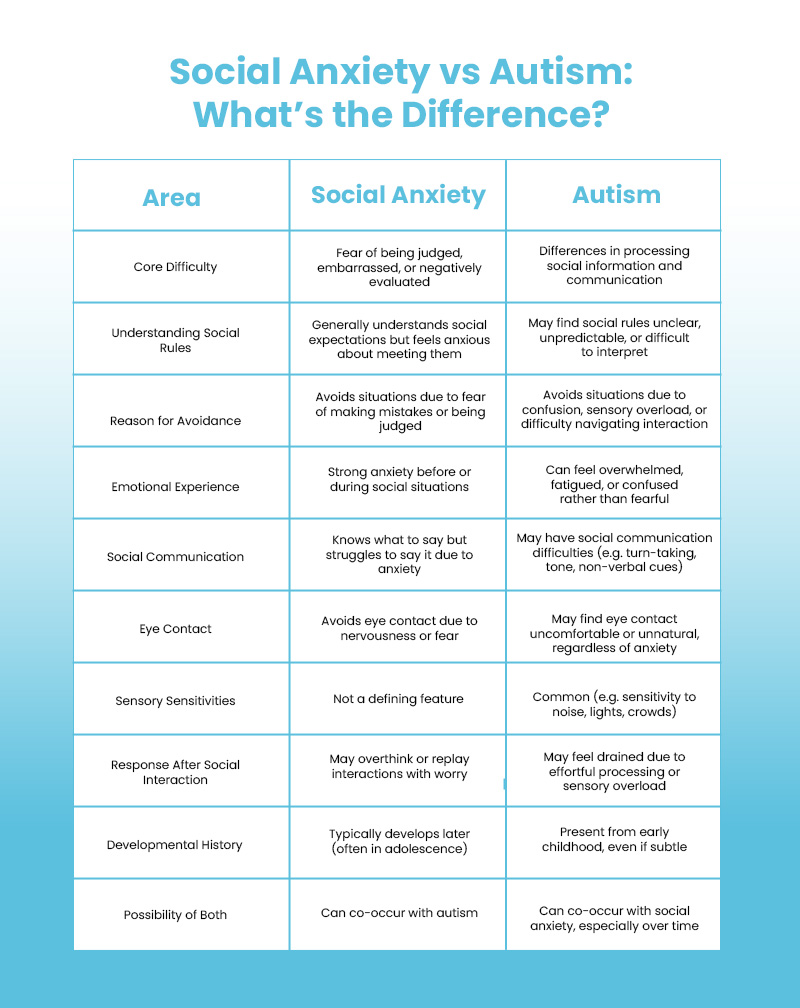
The distinction between social anxiety and autism lies less in the reason behind why social situations are difficult.
Social Anxiety: Fear-Based Avoidance
Social anxiety is typically associated with a fear of social situations, where individuals worry about being judged, embarrassed, or making mistakes.
- Social rules are generally understood
- The challenge lies in the fear of evaluation
- Avoidance is driven by anxiety about outcomes
Autism: Processing and Interpretation Differences
Autism-related social differences are more commonly linked to how social information is processed.
- Social rules may not be intuitive
- Conversations can feel effortful or unclear
- Sensory sensitivities may contribute to overwhelm
In children, this may present as communication difficulties, such as difficulty maintaining back-and-forth conversation or interpreting tone and facial expressions.
These are broad patterns rather than diagnostic rules. A careful understanding requires more than matching behaviours to descriptions.
Can Someone Experience Both?
It is possible for individuals to experience both conditions, which adds complexity to differentiating social anxiety from autism.
Some autistic individuals may also develop social anxiety over time. This often occurs following repeated experiences of misunderstanding, correction, or feeling out of sync in social settings such as school or group activities.
When both are present:
- Avoidance may be influenced by both fear and processing difficulty
- Social interaction may feel both confusing and stressful
- Emotional responses may be layered and harder to interpret
This overlap is one reason why autism can be misdiagnosed as social anxiety, especially when anxiety becomes the most visible concern.
Why the Overlap Is Often Missed
One reason confusion around distinguishing autism from social anxiety persists is timing.
Social anxiety is often identified later, particularly during adolescence when social expectations increase. Autism, especially when traits are subtle or masked, may not have been recognised earlier.
In Singapore, where academic and social expectations are structured from a young age, some children learn to adapt or “blend in” temporarily. Over time, this can lead to exhaustion, anxiety, or emotional strain.
As a result:
- Anxiety may overshadow underlying developmental patterns
- Autism-related traits may be interpreted purely as anxiety
- Support may focus only on confidence or exposure, without addressing deeper needs
This is why professionals place strong emphasis on developmental history rather than relying solely on present behaviour.
Why the Distinction Matters for Support
Understanding the distinction helps guide more appropriate and targeted support.
If support focuses only on anxiety:
- Sensory sensitivities may remain unaddressed
- Communication challenges may persist
If support focuses only on autism:
- Emotional distress linked to anxiety may be overlooked
A balanced understanding allows for:
- More tailored intervention strategies
- Greater clarity for parents and educators
- Reduced frustration from trial-and-error approaches
For younger children, early support such as speech therapy for kids can help build communication skills, while structured approaches like ABA treatments may support behavioural and learning needs when appropriate.
How AutismSTEP Supports Families in Singapore
For families navigating uncertainty around social anxiety and autism, structured and individualised guidance can make a meaningful difference.
At AutismSTEP, support is grounded in careful observation, developmental tracking, and practical strategies tailored to each child’s needs. Rather than focusing on labels alone, the approach considers how a child communicates, processes information, and responds to their environment over time.
Families can expect:
- Structured assessments that look beyond surface behaviour
- Practical strategies to support communication and daily routines
- Guidance that aligns with Singapore’s school and social environments
- Collaboration with parents to build consistency across home and learning settings
Working with an experienced autism specialist in Singapore helps families move from uncertainty to clarity, without rushing into conclusions.
Taking a Thoughtful Next Step
Descriptions of behaviour can be helpful for reflection, but they are not diagnostic. Differentiating between social anxiety, autism-related traits, or a combination of both requires careful, individualised consideration.
If you are trying to understand overlapping social challenges, taking a step back to look at patterns over time can provide a valuable perspective.
AutismSTEP supports families in making sense of these differences through structured guidance, helping parents move forward with clarity and confidence.
Contact us if you would like support in understanding communication disorders and what it may mean for your child to begin a conversation focused on insight.
 AutismSTEP